RESEARCH LIBRARY • STACKING GUIDE
Peptide Stacking Guide
Can multiple peptides be taken together—and are pre-mixed blends really inferior?
Researchers regularly raise two questions about combining peptides. The first is practical: can multiple peptides be run within the same protocol? The second concerns formulation: whether pre-mixed blends such as KLOW are less effective than the same peptides sourced individually, on the theory that the peptides interact in the vial. This guide addresses both.
Can multiple peptides be stacked?
Yes. Peptides are signaling molecules—each one acts on its own receptor or pathway. Because the targets are different, running multiple peptides together generally does not create interference: each peptide simply does its own job.
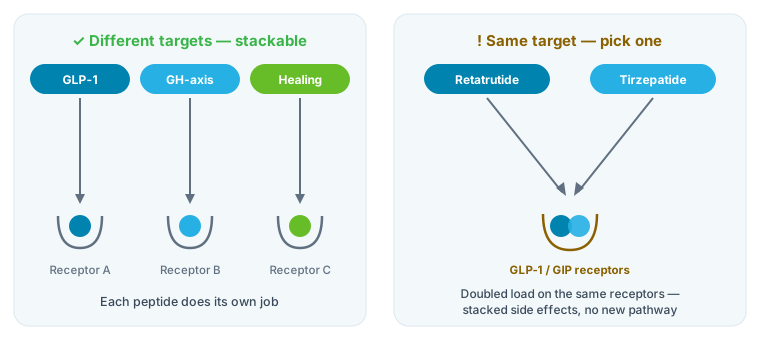
This is different from the drug-interaction picture people know from small-molecule medications, where two drugs often compete for the same liver enzymes. Peptides are broken down by the body’s general protein-handling machinery, not a narrow enzyme bottleneck—so stacking across different targets is standard practice in research protocols.
The exceptions: don’t stack the same target twice
Same receptors: Retatrutide + Tirzepatide
Retatrutide and Tirzepatide both switch on the GLP-1 and GIP receptors (Retatrutide adds glucagon). Stacking them does not open a new pathway—it doubles the load on the same receptors, stacking side effects without complementary benefit. Choose one. If the goal is more effect, the answer is the compound’s own titration schedule—or a switch—not a second incretin on top. (See the GLP-1 switching guide.)
Blends + their own components
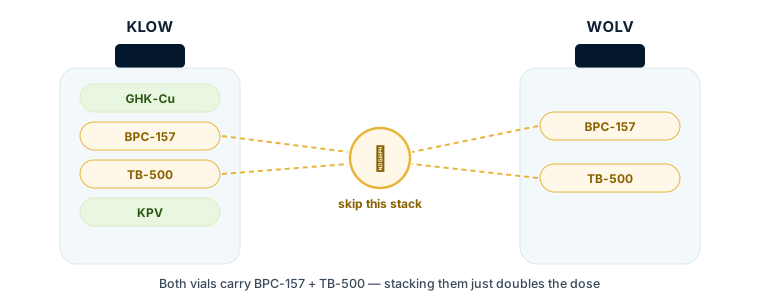
The same logic applies to blends. GLOW already contains GHK-Cu, TB-500, and BPC-157; KLOW contains those three plus KPV. So you would not stack the BPC-157/TB-500 blend (the “WOLV” stack) with GLOW or KLOW, and you would not add any of the individual sub-peptides—GHK-Cu, BPC-157, TB-500, or KPV—on top of a blend that already includes them. That is not a dangerous interaction; it is just double-dosing ingredients already in the vial.
Different pathways, same outcome: the GH peptides
Generally, pick one growth-hormone peptide. The nuance is that they genuinely do work different routes: Tesamorelin and Sermorelin act on the GHRH receptor, while the Ipamorelin half of Ipamorelin/CJC-1295 acts on the separate ghrelin receptor—and some researchers stack them on exactly that basis. But both routes end in the same place: one growth-hormone pulse from the pituitary. Stacking two of them mostly piles extra stimulus onto a single output rather than opening a genuinely new dimension. (Ipamorelin/CJC-1295 already combines both routes in one vial—if dual-pathway release is the goal, that is the purpose-built way to get it.) See the Three Pathways comparison for how the options differ.
| Combination | Verdict |
|---|---|
| Peptides with different receptor targets (e.g., a GLP-1 + a GH-axis peptide + a healing blend) | Stackable—each works its own pathway. |
| Retatrutide + Tirzepatide | Pick one—same incretin receptors, doubled side-effect load. |
| Two GH-axis peptides (e.g., Tesamorelin + Ipamorelin/CJC-1295) | Generally pick one—different receptors, but the same GH-pulse outcome. |
| BPC-157/TB-500 (WOLV) + GLOW or KLOW | Skip—the blend already contains both peptides. |
| A blend + one of its own sub-peptides | Skip—that is double-dosing an ingredient, not a new pathway. |
One practical habit
When building a stack, add one peptide at a time and give it long enough to judge before adding the next. If everything starts on the same day, you cannot attribute either the benefits or the side effects to any single compound.
The pre-mix criticism
A common claim in peptide forums goes like this: pre-mixed stacks like KLOW are inferior to buying the peptides separately, because the peptides “interact” when stored in one vial. GHK-Cu gets singled out as the culprit—it carries a copper ion, copper is described as “reactive,” and the conclusion is that the copper attacks the other peptides in the blend.
We looked into the actual chemistry behind this claim, and it does not hold up.
What the chemistry actually shows
GHK-Cu’s copper is tightly bound, not free
The “reactive copper” concern describes free copper ions—loose Cu²⁺ in solution, which genuinely can catalyze oxidation. But that is not what GHK-Cu is.
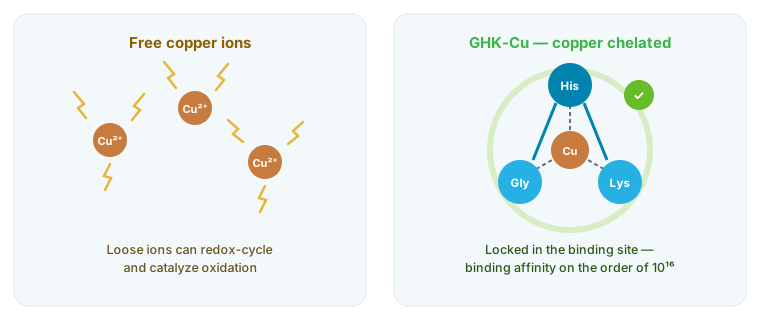
GHK grips copper about as tightly as anything in biology does—tightly enough that the body uses it to ferry copper around in the bloodstream. Chelation is exactly the mechanism that stops copper from redox-cycling and attacking other molecules—the tight binding that makes GHK-Cu what it is also defuses the “reactive copper” objection.
No credible evidence of pre-mix degradation
Beyond the copper chemistry, we searched for any credible published evidence that peptides co-formulated in one vial degrade each other or lose effectiveness compared with the same peptides stored separately. We could not find any. The claim circulates as forum lore, repeated from post to post—not as data. Peptides are routinely co-formulated in research and pharmaceutical settings, and the factors that actually threaten peptide integrity are the same whether a vial holds one peptide or four.
What actually matters for peptide integrity
Reconstitute right
Bacteriostatic water, swirled gently—never shaken.
Store cold & clean
Refrigerated, away from light and heat, with a fresh syringe and wiped septum every draw.
Respect the window
Use the vial within its expected in-use period rather than stretching it for months.
These apply equally whether a vial holds one peptide or four. For the full procedure, see the Reconstitution & Storage Guide.
Related research
Explore the research catalog
Browse individual peptides and pre-mixed research blends at BLP Research.
Visit BLP Research →Research use only
This reference is provided for laboratory and research purposes only. All materials are sold and offered strictly for research use and are not intended to diagnose, treat, cure, or prevent any disease. Statements have not been evaluated by the Food and Drug Administration.