
RESEARCH LIBRARY • TOPICAL PREPARATION
GHK-Cu Topical Preparation Reference
A method for preparing a GHK-Cu topical serum using 100mg vials, bacteriostatic water, and a hyaluronic acid base.
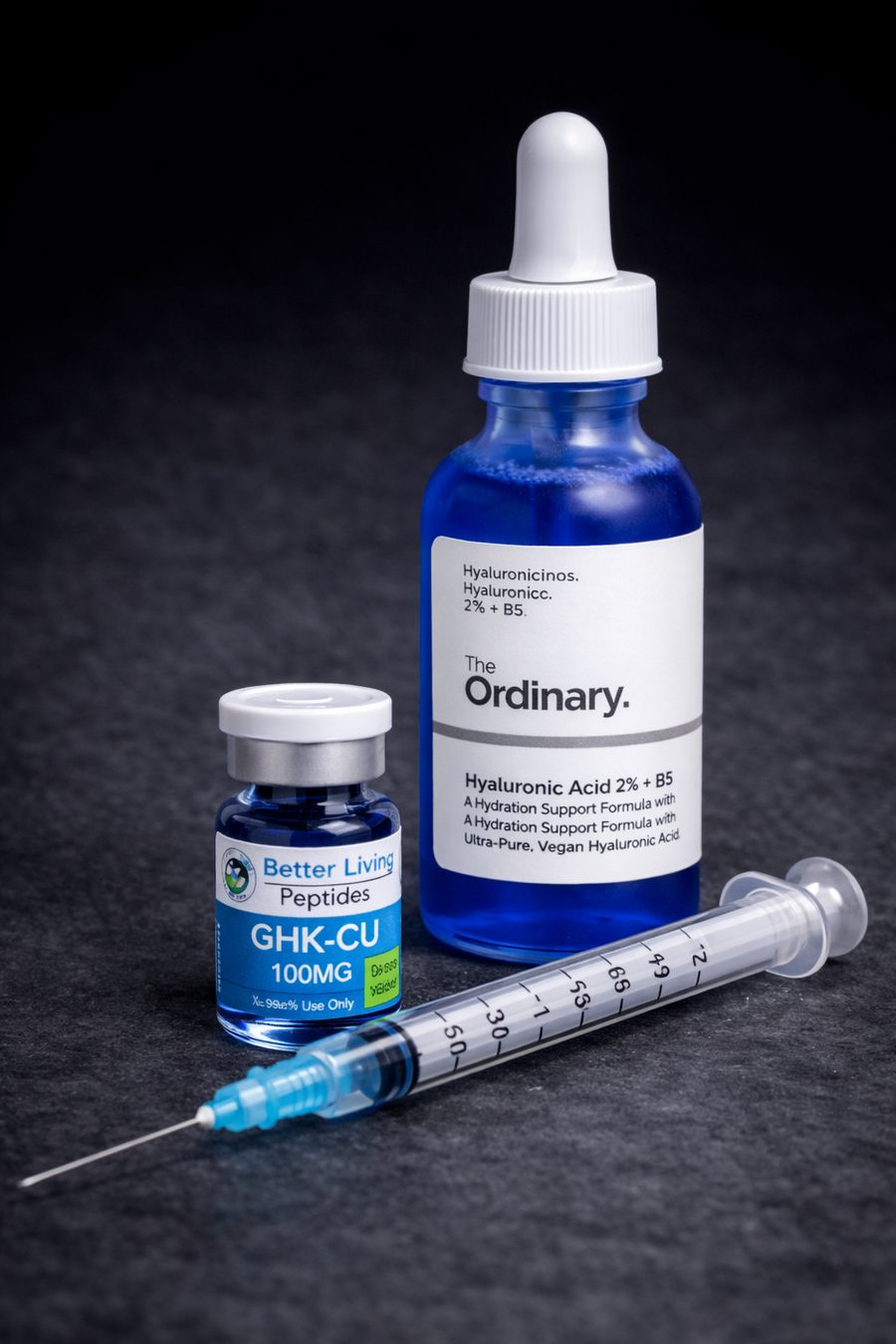
This reference provides a simple, effective method to create a GHK-Cu topical serum using 100mg GHK-Cu vials, bacteriostatic water (BAC water) for reconstitution, and The Ordinary Hyaluronic Acid 2% + B5 as the base — resulting in a water-based, preservative-included formula.
Safety notes
- Sanitize vial tops, tools, and workspace with alcohol wipes.
- Swirl and roll gently — no hard shaking, to protect the peptide.
- Store lyophilized vials in the fridge or freezer.
- Refrigerate the final serum (2–8°C); use within 30–60 days.
- Patch test on the inner forearm for 24–48 hours.
- Discontinue if irritation occurs.
- Cosmetic use only — results are gradual.
Tools and materials needed
- 1–3 × 100mg GHK-Cu lyophilized vials
- Bacteriostatic water (BAC water)
- The Ordinary Hyaluronic Acid 2% + B5 serum (30 mL bottle) — used as the base; it is water-based and preservative-included for stability
- 3 mL sterile syringe (for precise BAC transfer)
- Alcohol wipes for sanitizing
Step-by-step preparation
- Prepare your workspace (5 minutes)
- Clean your counter with alcohol.
- Wipe the rubber tops of both GHK-Cu vials and the BAC water vial with alcohol wipes.
- Let everything air-dry briefly.
- Reconstitute each GHK-Cu vial (one at a time)
- Draw 1.5 mL BAC water into a sterile syringe.
- Slowly inject the 1.5 mL BAC water down the side of the GHK-Cu vial wall (avoid a direct blast on the powder to prevent foaming or degradation).
- Remove the needle/syringe.
- Gently swirl or roll the vial between your palms (do not shake vigorously).
- Let it sit for 10–30 minutes at room temperature (or longer if needed) until fully dissolved and clear, with no visible particles or cloudiness. If clumps remain, gently swirl again — avoid heat or force.
- Combine with the hyaluronic acid base
- Wipe the dropper tip and rim of the HA bottle with alcohol.
- Use a fresh sterile syringe to draw up the full reconstituted solution from the first GHK-Cu vial (~1.5 mL).
- Carefully inject it into the HA bottle through the opening (remove the dropper if needed for easier access).
- Repeat for each additional vial (another ~1.5 mL each). Total added: ~1.5–4.5 mL.
- Cap the bottle tightly.
- Gently roll or swirl the bottle for 2–3 minutes to mix evenly (no vigorous shaking).
- Label and store
- Label the bottle: “GHK-Cu HA Serum – Made [date] – Use by [date 4–6 weeks out] – Fridge only”.
- Store immediately in the refrigerator (2–8°C). Keep away from light (wrap in foil if the bottle is clear).
Concentration reference
The number of vials you use determines the final concentration of the serum.
| Number of 100mg vials | Total GHK-Cu | Approx. final volume | Concentration (% w/v) grams per 100mL of serum |
|---|---|---|---|
| 1 | 100 mg | ~31 mL | ~0.3% |
| 2 | 200 mg | ~33 mL | ~0.6% |
| 3 | 300 mg | ~35 mL | ~0.9% |
Application
- Apply 2–4 drops AM and/or PM to clean, dry skin. Can also be microneedled into skin or scalp for deeper penetration.
- Gently pat in; let absorb fully (1–2 minutes) before moisturizer or other products.
- Use sunscreen daily (peptides don't increase photosensitivity, but it's a good habit).
- Start slow: use every other day at first to monitor for irritation (redness, stinging).
How long does it last?
Typical application is 2–4 drops, giving roughly 30–45 days per bottle.
Expected timeline
Related research
Need GHK-Cu?
100mg GHK-Cu vials and bacteriostatic water are available at BLP Research.
Shop GHK-Cu →Research use only
This reference is provided for laboratory and research purposes only. All materials are sold and offered strictly for research use and are not intended to diagnose, treat, cure, or prevent any disease. Statements have not been evaluated by the Food and Drug Administration.